
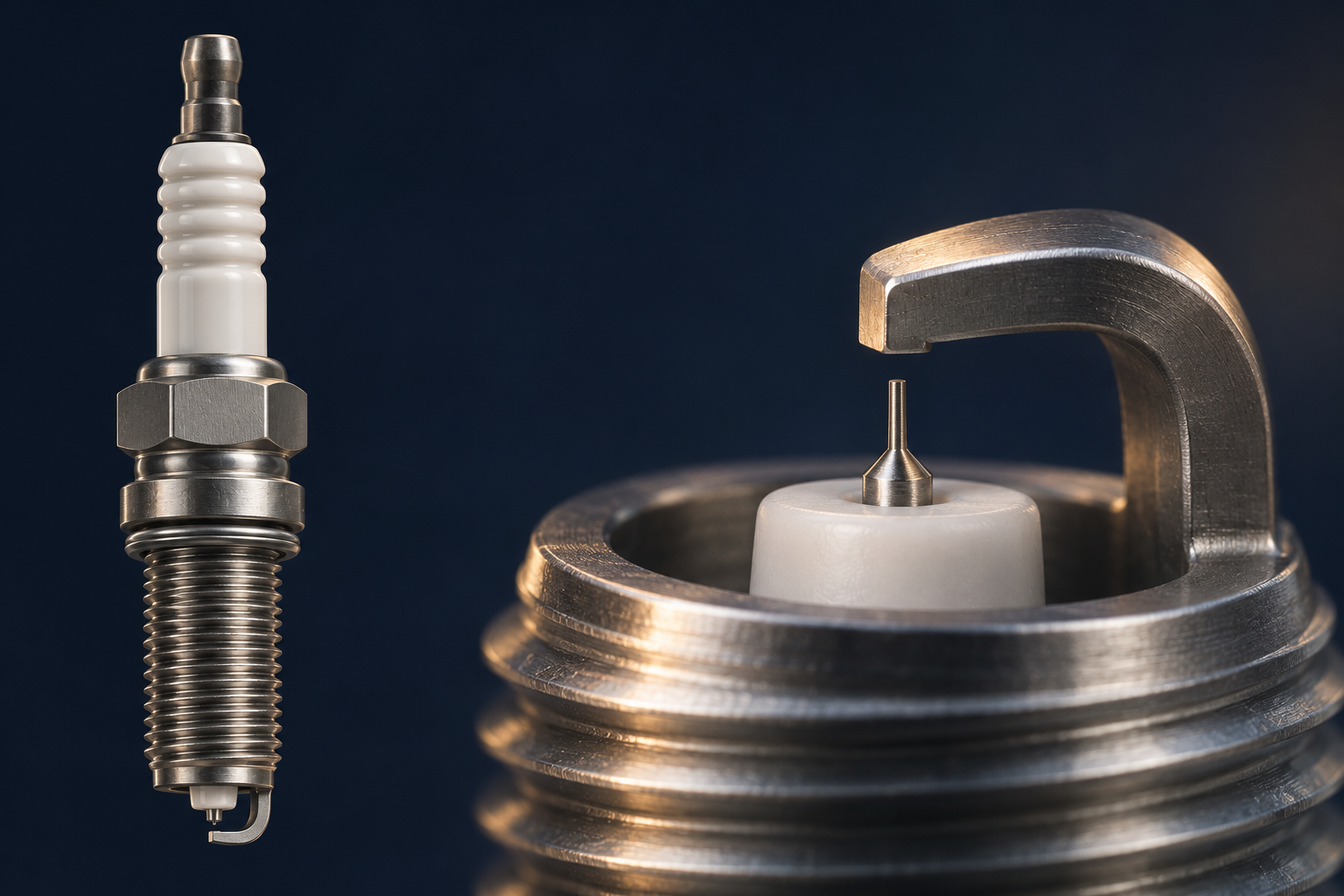
Conceptual AI-generated illustration, not an archival photograph or a specific Denso product.
Denso’s spark plug story connects materials research with ignition engineering. From its early plug production to fine iridium tips, the recurring challenge has been reliable ignition supported by suitable geometry and durability. Material, electrode shape and engine requirements belong in the same engineering discussion.
From Nippondenso to Denso
Denso was established on 16 December 1949 and is headquartered in Kariya, Aichi, Japan. It became an independent company after separating from Toyota and was known as Nippondenso. The company adopted the Denso name in 1996. Spark plugs form one part of this wider automotive component history. [1][2]
The laboratory and early plug generations
Denso’s official plug history records a spark plug laboratory in 1957 and engineer exchanges from 1958 to learn manufacturing technology. Technical cooperation with Bosch contributed to this stage, connecting the story with Bosch’s ignition history. [3]
The Japanese timeline lists the P2 plug in 1959, P3 in 1962 and Wide plug in 1970. These milestones trace the development of the plug range; the company’s foundation date is distinct from the start of its spark plug production. [4]
Grooves and electrode shape
The Japanese timeline records U-groove plug generations in 1975. This development concerns more than the metal used: ground-electrode geometry also matters to the environment in which the initial flame kernel forms. [4]
Denso describes a U-groove and tapered ground electrode among the design features of Iridium Power. The taper is intended to reduce the electrode’s flame-quenching effect. The product page lists exceptions for specific part numbers, so these features must be read within the scope of the relevant family and model. [5]
Iridium: development and product introduction
Denso’s global and Japanese histories date iridium plug development to 1997 and the introduction of Iridium Power with a 0.4 mm centre tip to 1998. Its European twentieth-anniversary report instead dates the first 0.4 mm generation to 1997. This article preserves the scope of both official accounts: technology development in 1997, followed by Iridium Power’s 1998 introduction in the Japanese timeline. [3][4][6]
The engineering theme is a fine tip made possible by a wear-resistant alloy. Reducing electrode diameter and selecting a suitable material are connected decisions. Tip diameter alone does not fully describe a plug’s performance or service life.
Why a fine tip matters
Denso explains that Iridium Power’s 0.4 mm centre electrode helps reduce the voltage required to produce a spark. Ground-electrode design also affects the conditions in which the flame begins. This describes a design mechanism, rather than a uniform power or fuel-economy improvement for every vehicle. [5]
Denso iridium plugs do not all have the same electrode diameter. Its official identification tables include 0.4, 0.55 and 0.7 mm designs, depending on the series. Iridium therefore identifies a material used across multiple designs; the exact specification comes from the part number. [7]
Two fine tips and later families
The Japanese history lists a double-needle iridium plug in 2003 and TT plugs in 2008. Denso’s October 2015 European Iridium TT announcement describes a 0.4 mm iridium centre tip paired with a 0.7 mm platinum ground-electrode tip. [4][8]
A 2019 European anniversary report dates Nickel TT’s introduction to 2009, whereas the 2015 announcement and Japanese timeline refer to 2008. The source record retains this discrepancy. A regional introduction date is not treated as the first global milestone without evidence. [8][9]
What this history tells us
Denso’s progression illustrates how material, geometry and application work together. Different families address different requirements; a brand name or tip diameter cannot replace the correct part-number selection. Heat range, installation dimensions and electrode gap need to match the vehicle manufacturer’s recommendations and application catalogue.
For the wider context, read spark plug history and NGK’s history and technical ceramics. Salehyar presents this series to support technical understanding of brands; available product listings and part numbers can be explored in the catalogue.