
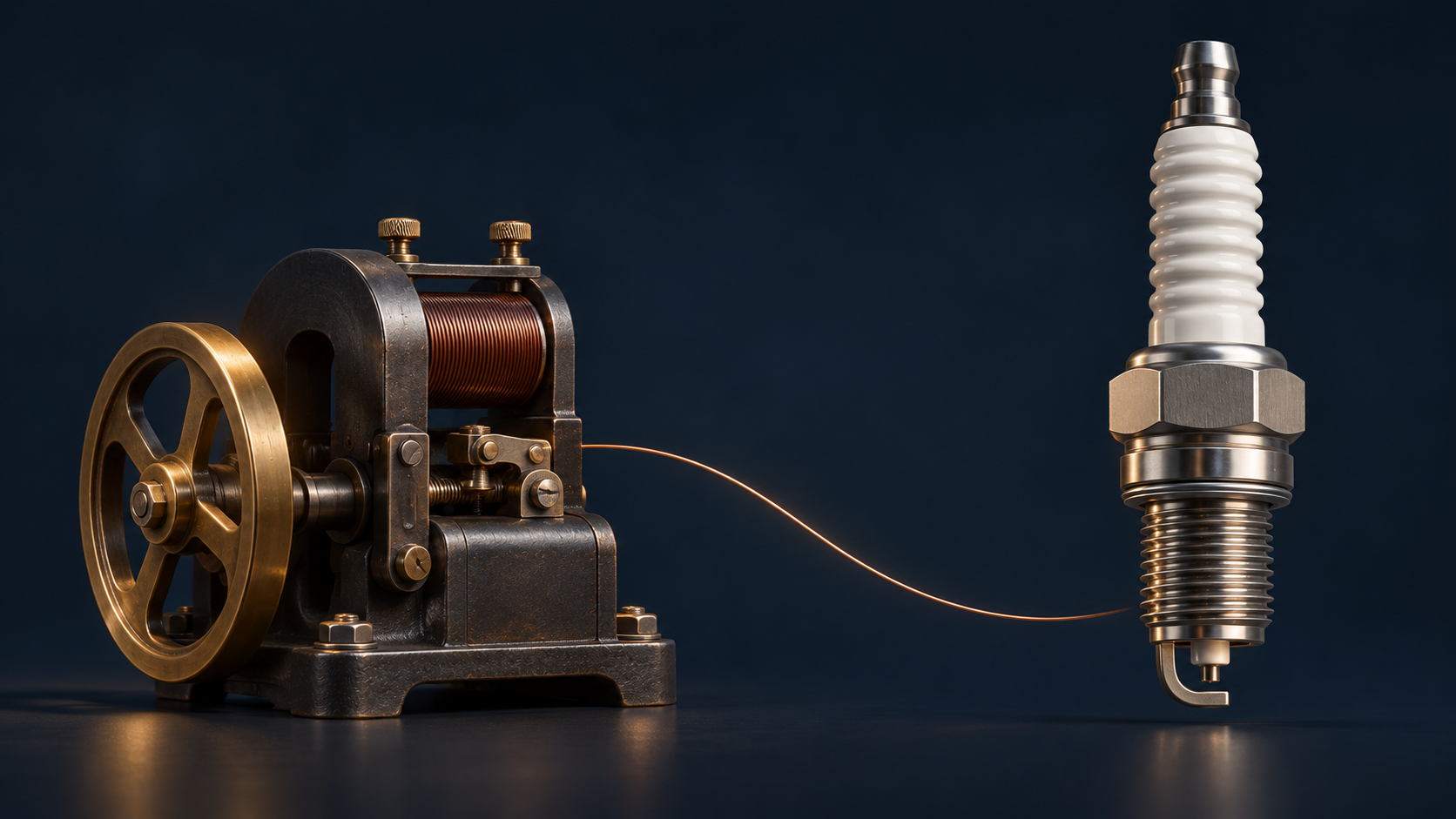
Conceptual AI-generated illustration, not a reconstruction of a historic magneto or a specific Bosch product.
Small components can leave a lasting mark on automotive engineering by solving a much larger problem. Bosch spark plugs are one example: their industrial development was closely connected with a new ignition system, and their design and materials continued to change as petrol engines evolved. The story begins when producing a dependable spark was still a major challenge for engine designers.
Bosch identifies 1902 as a clear milestone: the introduction of a high-voltage magneto ignition system with a spark plug. Its significance lay in bringing together voltage generation, energy transfer and the spark inside the combustion chamber. Looking at that complete system helps explain Bosch’s contribution to automotive technology.[1]
From the Stuttgart workshop to automotive ignition
Robert Bosch opened his workshop for precision mechanics and electrical engineering in Stuttgart in 1886. The workshop initially undertook a variety of jobs, but magneto development became an influential part of its work. According to Bosch’s corporate history, the company began fitting improved magneto ignition devices to motor vehicles in 1897.[1]
A magneto generated the electrical energy needed for ignition. Generating electricity was only part of the challenge: that energy had to reach the combustion chamber at the right moment to ignite the air–fuel mixture. Early systems used mechanical arrangements whose maintenance and adaptation to an engine added to the design challenge.[2]
For a broader account of this period and the contributions of other manufacturers, see our history of the spark plug. This article focuses on Bosch’s solution and its subsequent development.
Gottlob Honold and the high-voltage solution
In the summer of 1901, Bosch asked Gottlob Honold to develop a magneto that would no longer depend on the conventional mechanical break-spark arrangement. In the resulting high-voltage system, a cable carried electrical energy to a spark plug, where a spark jumped between its electrodes. Bosch records this development in its innovation history under 1902.[2]
The change becomes easier to understand by following the energy: voltage generation, transmission and finally the spark across the electrode gap. The spark plug formed the endpoint of that path inside the engine. Its operation and the design of the ignition system therefore needed to be considered together.
Honold’s role also illustrates how a successful component brings together several engineering disciplines. Electrical connections, insulation and the ability of parts to withstand engine conditions all contribute to a workable system. Bosch’s official history credits him with introducing the high-voltage magneto and spark plug combination.[1]
Why 1902 matters
Bosch’s anniversary chronology describes the 1902 event as a patent for a high-voltage magneto combined with a spark plug.[3] The scope of that development matters: it concerns the combined ignition system, rather than establishing Bosch as the sole inventor of the spark plug itself.
This distinction makes the engineering achievement clearer. The spark plug worked as part of a coordinated system that produced a spark where the engine needed it. In industrial development, solving the complete operating problem is as significant as the idea behind an individual part.
From producing a spark to understanding heat behaviour
As petrol engines became more widespread, the requirements placed on spark plugs became more precise. Alongside their electrical role, plugs had to suit an engine’s thermal conditions. Bosch’s official chronology records the introduction of a heat-rating scale in 1927.[3]
This stage highlights the link between spark plug selection and engine characteristics. Brand history can explain how that knowledge developed; choosing a particular plug still requires the recommended part number and specifications for the engine concerned. A long product history does not establish universal compatibility across a manufacturer’s range.
Motorsport, electrodes and new materials
Bosch’s chronology records dedicated motorsport spark plugs in 1935 and precious-metal plugs for endurance racing in 1969. Later milestones include a platinum centre electrode in 1983 and nickel–yttrium electrodes in 1995.[3]
These dates trace a shift in engineering attention. Alongside reliable ignition, durability and material behaviour became increasingly important. The changes went beyond product names or appearance: the small working surfaces of the electrodes made material selection and manufacturing methods particularly significant.
In its technical discussion of present-day plugs, Bosch distinguishes between non-precious-metal versions, usually with nickel electrodes, and versions using precious metals. The same source identifies the use of precious metal on both the centre and ground electrodes in the 2000s as another development in its range.[4] Service life must be taken from the guidance for the specific plug and the vehicle’s maintenance schedule; this history supplies no universal replacement interval.
Our history of NGK and technical ceramics offers another perspective on materials, showing how insulation technology became a foundation of spark plug development.
Modern engines and continuing development
Higher operating pressures and turbocharging create additional requirements for spark plug insulation and design. In its technical interview, Bosch describes the introduction of EVO spark plugs in 2019 for turbocharged petrol direct-injection engines as one response to these requirements.[4]
The underlying principle remains consistent: the plug’s specifications must suit the engine and ignition system. The difference between older and newer engines extends beyond power output to the conditions in which the plug operates and the demands placed on its construction.
A Bosch technical page for a two-wheeler spark plug family describes features including a copper-core centre electrode, an interference-suppression resistor and a plated shell.[5] This example shows how several coordinated parts form a spark plug. Those features belong to the family described on that page and should not be assumed for every Bosch part number.
What Bosch’s history tells us about today’s spark plug
Bosch’s spark plug story starts with an ignition problem and develops into a combination of electrical, thermal and materials engineering. The 1902 system, heat-rating development and changing electrode materials are different chapters in that progression. For professional readers, the value lies in understanding why designs differ and why individual specifications matter.
To learn about our business, visit About Salehyar, or browse the spark plug catalogue. This article explores the history of technology; selecting a part for a particular vehicle requires a separate check of engine specifications and application information.
Sources
- Bosch, “1886–1905: From first workshop to factory.” ↩1↩2↩3
- Bosch Mobility, “Milestones,” entries for 1897 and 1902. ↩1↩2
- Bosch Aftermarket, spark plug and glow plug anniversary chronology, page 2; spark plug entries only. ↩1↩2↩3
- Bosch Aftermarket, technical interview on spark plug history and technology, pages 1–2. ↩1↩2
- Bosch Mobility, “Spark plug,” technical page for two-wheeler applications. ↩1