
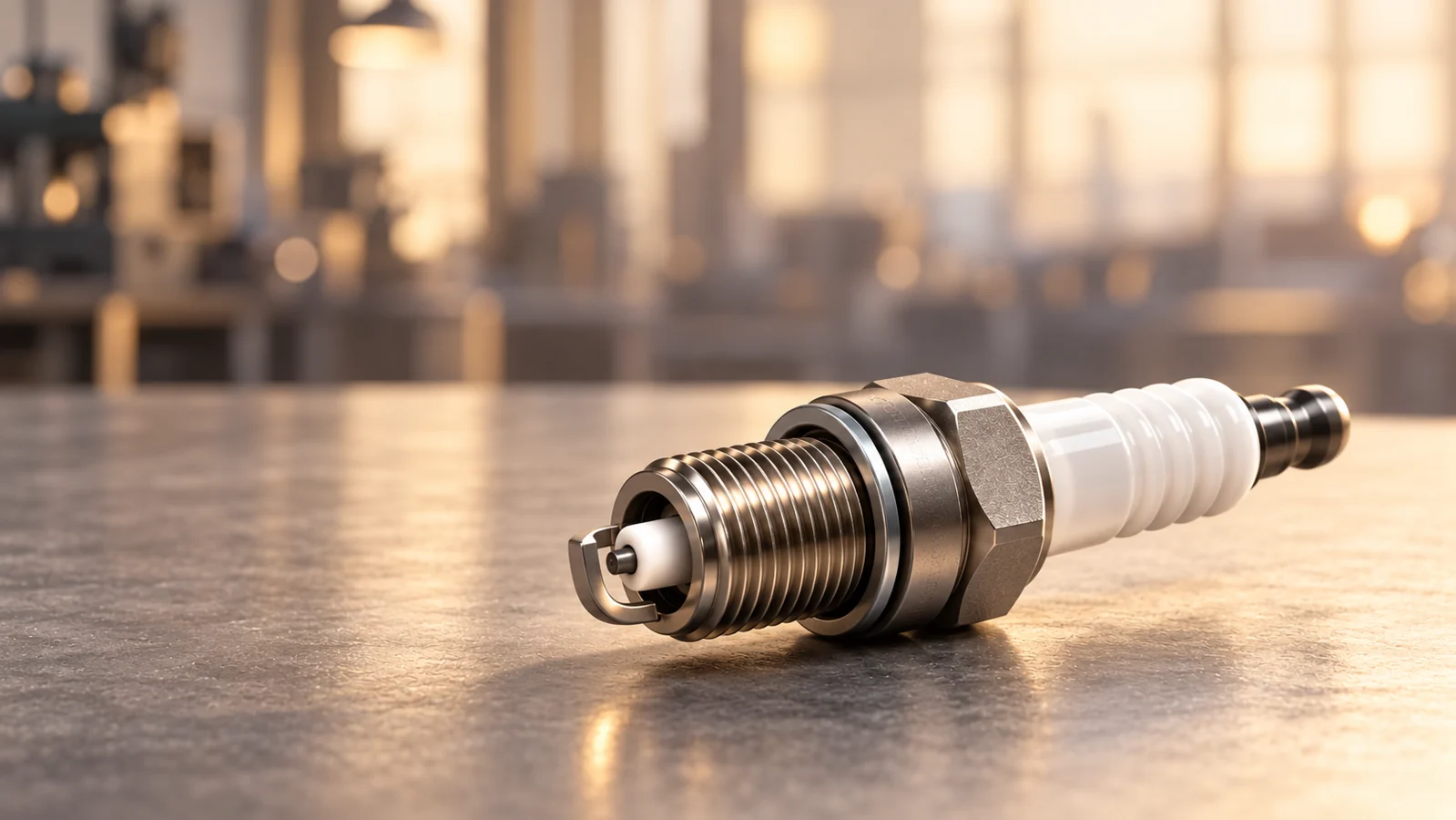
AI-generated conceptual illustration; not an archival factory photograph or a specific product model.
Nagoya: roots in ceramic expertise
NGK is a familiar name in automotive spark plugs. Its history connects Nagoya, ceramic materials and electrical insulation with later developments in spark plugs, sensors and technical ceramics. The history of the independent company, its predecessor businesses and its product brands are distinct parts of that story.
Niterra’s corporate timeline records research into white hard porcelain at the Nagoya branch in 1899. This belongs to the earlier industrial group; it is not the founding date of the independent spark plug company. In 1919, the electrical insulator division became a separate business. Spark plug research began there in 1921, followed by a spark plug release in 1930. The spark plug division itself became an independent company in 1936, the company later renamed Niterra in English.
The connection is an engineering one: insulating electricity and making a component for a hot engine both depend on understanding materials and controlling manufacture. For the wider context, see our spark plug history. [1]
1937: production under the NGK brand
The independent spark plug company was founded in Nagoya in 1936. Niterra’s historical account dates the start of production under the NGK brand to April 1937. Research in a predecessor company, incorporation of a separate business and production under a brand are therefore different milestones.
The company’s account describes Japanese porcelain expertise as one of the foundations of this development. Knowledge gained in making a material found a new automotive application. A working spark plug required a spark, but its manufacture also depended on suitable insulation, reliable joints and precise construction. [2]
The white insulator: an engineered component
The white part of a spark plug is more than an outer covering. NGK’s technical explanation identifies aluminium oxide, or alumina, as the ceramic used in most modern spark plug insulators. The material must provide electrical insulation while meeting requirements for heat transfer and resistance to thermal and mechanical shock.
Ceramic here means a material with specific composition and properties. Insulator geometry and manufacturing quality matter alongside the metal shell and electrodes. The familiar plug brings electrical engineering, mechanical design and materials science together.
This explains the role of the material; it does not establish that any particular part number suits a given engine. Our spark plug guide covers the components and practical selection in more detail. [3]
Beyond spark plugs: technical ceramics
In 1949, the company expanded technical ceramic activities under the NTK name. Its historical account describes a move into products beyond spark plugs. The corporate timeline also records ceramic cutting tools in 1958.
Ceramic integrated-circuit packages followed in 1967. Niterra’s account connects their development with glass sealing, metallisation and plating technologies. Automotive oxygen sensors appear in the corporate timeline in 1982.
These examples illustrate how industrial knowledge can cross product boundaries. Experience with precise electrical and thermal requirements can provide a foundation for further research. Each application nevertheless needs its own design and testing; a shared technological background does not mean that all products use identical materials or processes. [2]
1959: manufacturing expands to Brazil
NGK established its first spark plug factory outside Japan in Brazil in 1959. The official regional history records this milestone, while Niterra’s narrative identifies Brazil as its first overseas base. Later expansion formed part of the company’s development into an international business.
A factory, a sales subsidiary and a product brand serve different roles in that story. Opening an office in a country does not itself mean that manufacturing began there. These historical milestones should therefore not be used to infer the country of manufacture of every plug sold under the brand. [4]
Niterra and NGK: company name and product brand
The company adopted Niterra as its English corporate name in April 2023. Its official announcement in Brazil stated that the NGK brand for ignition-related products and the NTK brand for sensors would remain. The corporate name change did not retire the NGK spark plug brand.
This distinction makes current sources easier to read: corporate reports and history may appear under Niterra, while spark plugs continue to be presented under NGK. The story links ceramic expertise in Nagoya with decades of development in materials, manufacturing and new applications.
For professionals, that history provides context for the technology. For an individual product, the complete part number and manufacturer information remain the reference. Browse the models presented in the Salehyar product catalogue and enquire about the part number you need. [5]
Learn more about Salehyar, or explore the models and part numbers in our spark plug catalogue.