
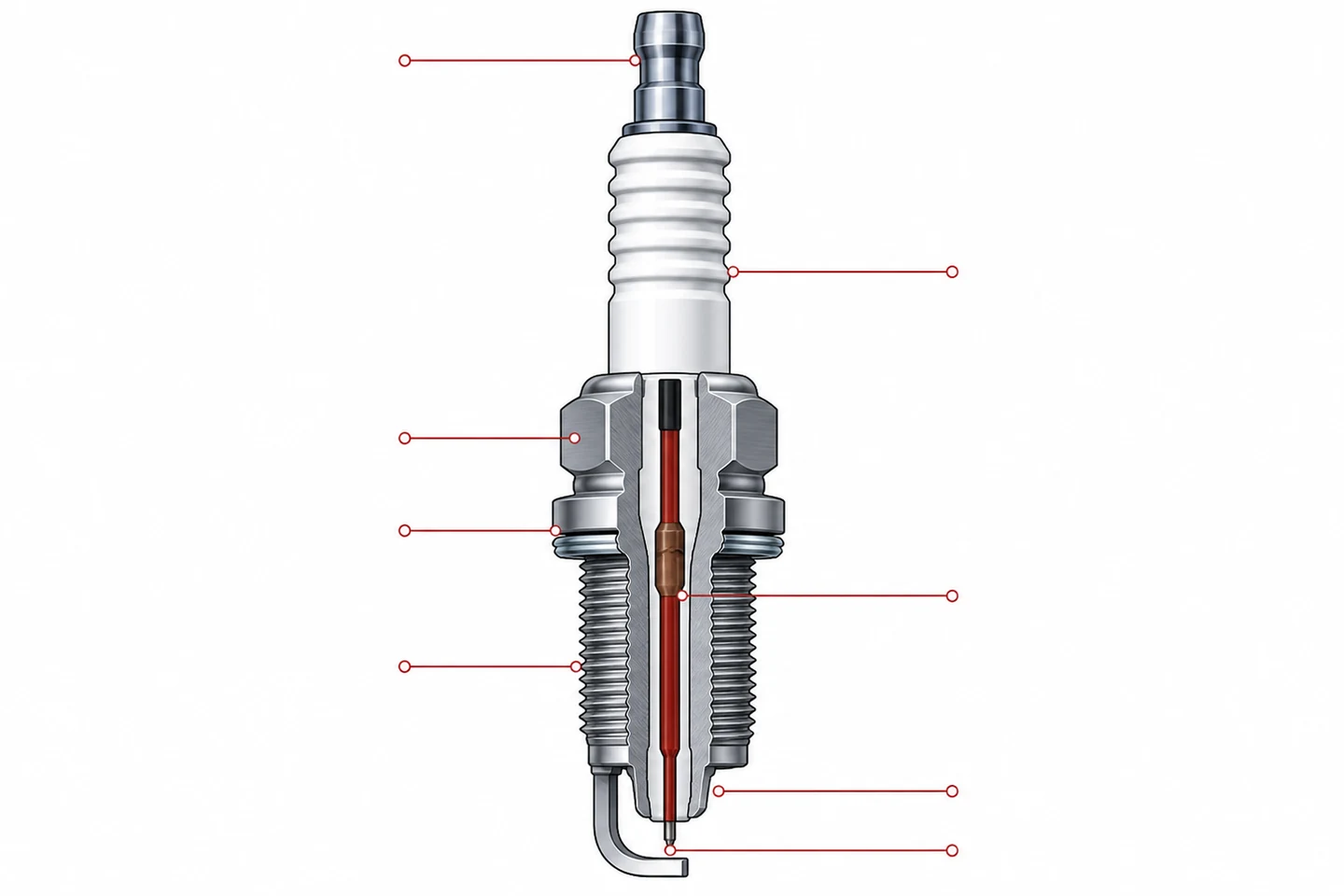
A spark plug is the component in a spark-ignition engine that turns the ignition system’s high voltage into a spark across the gap between the centre and ground electrodes. Correct selection is based on part number, engine specification, thread dimensions, seat type, heat range and specified gap—not merely plug appearance, brand name, or market terms such as long-reach and short-reach.
An unsuitable plug can look very similar to the previous one, yet a difference in thread reach, heat range, internal resistance or electrode gap can cause poor running and may lead to damage. This guide helps buyers, parts sellers, distributors and technicians select automotive spark plugs from technical data and recognise when a manufacturer catalogue or specialist advice is needed for a precise fitment check.
This article has been written by comparing official technical guidance from established manufacturers including NGK/NTK, DENSO, Bosch, BERU, Champion and BRISK. It is not copied from, or a literal translation of, any one source, and it accounts for differences between manufacturers’ naming systems.
What is a spark plug and how does it work?
In a petrol or gaseous-fuel spark-ignition engine, the compressed air-fuel charge must ignite at the calculated moment. The ignition system generates high voltage and the spark plug carries it into the combustion chamber. When the voltage exceeds the insulating capability of the electrode gap, a spark jumps and combustion begins.
A spark plug does more than create a spark: it also transfers part of the combustion chamber heat from its firing end to the cylinder head. Insulator design and projection, electrode material and shape, and the way the plug shell contacts the cylinder head all influence this process. This is the basis of the heat-range concept.
Main parts of an automotive spark plug
Exact terminology can vary slightly between manufacturer catalogues, but most automotive spark plugs include the following elements:
- Terminal for the ignition lead or coil
- Ceramic insulator resistant to voltage and heat
- Internal resistor for electromagnetic-noise suppression in resistor plugs
- Metal shell and hex for the plug socket
- Thread and thread reach into the cylinder head
- Sealing washer or taper seat
- Centre electrode
- Ground electrode and spark gap
A copper core in many designs improves heat transfer, but it is inaccurate to call every conventional plug a “copper plug”. The firing surface may use nickel alloy or precious metals such as platinum and iridium, while the internal core can have a different construction.
Why do physical dimensions matter?
Thread diameter and pitch, reach, seat type and hex size need to match the cylinder head. Too little reach can place the spark away from its intended position; excessive reach can risk contact with internal parts or carbon build-up on exposed threads. “Long-reach” and “short-reach” are useful market shorthand, but they are not enough for a professional order.
Selecting a plug by part number and engine application
The safest starting point is the recommended part number for that exact vehicle and engine. Model year, engine size and code, ignition system, and even the vehicle’s market specification can change the required plug. Two vehicles sold under the same model name may have different engines and therefore different plugs.
For an accurate fitment check, consider these details together:
- Vehicle make, model and model year;
- Engine displacement and engine code, where available;
- The current plug part number or OE part number;
- Thread diameter, pitch and reach;
- Seat type: gasket or taper seat;
- Heat range, internal resistance and specified gap;
- Electrode type and design.
Cross-reference tables can help identify an equivalent option, but a cross-reference must not be based on one number or visual similarity alone. Manufacturers do not use identical naming systems for heat range and plug construction. A heat-range number from one brand cannot simply be treated as the same number in another.
Spark plug fitment for imported vehicles and newer engine generations
The growth of imported vehicles and newer engine generations has made accurate plug fitment more important. A plug used for years in a familiar engine or an older vehicle generation does not become suitable for another engine merely because it looks alike or is described as long-reach. Model year, engine code, market specification and engine version can all affect the required part number.
When heat range, thread reach or diameter, seat type, resistance, firing position or gap do not match the engine design, a plug may run too hot or too cold. Possible consequences include deposits, poor running, early wear, overheating of the firing end or a higher pre-ignition risk. These symptoms do not prove that the plug alone is at fault; fuel quality, ignition coils, injectors, compression and engine management also belong in the diagnosis.
For a professional check, the current plug part number, exact vehicle details, model year and, where available, engine code are reviewed together. Comparing these data with the manufacturer’s application catalogue reduces selection by guesswork or market habit. In specialist enquiries, Salehyar uses engine application and part number as the basis for guidance.
Spark plug types and electrode materials
Many differences between plugs on the market concern the firing-electrode material, centre-electrode tip diameter, number of ground electrodes and firing-end geometry. No group is automatically best for every vehicle. The best choice is the one whose specification matches the engine design and manufacturer recommendation.
| Common type | Key characteristic | Selection note |
|---|---|---|
| Nickel alloy | Common, economical design for many applications | Suitable where the vehicle calls for this specification |
| Platinum | Greater wear resistance at the firing surface | Single- or double-platinum design must match the ignition system and part number |
| Iridium | Allows a fine, wear-resistant centre tip | It is not a correct substitute without checking part number and gap |
| Multi-ground electrode | More than one ground electrode in the design | More electrodes do not mean simultaneous multiple sparks or more power |
Is iridium always better?
Iridium is highly wear-resistant and permits a fine centre tip, but “better” only has meaning when its part number, dimensions, heat range and gap are approved for the engine. Installing an unrelated iridium plug instead of the specified plug is not an upgrade.
What is the difference between single-platinum, double-platinum and multi-electrode plugs?
In a single-platinum plug, platinum is normally present on one side of the firing path. In a double-platinum design, both opposing firing surfaces may use platinum. This can matter in ignition systems where current direction varies between plugs. In a multi-ground-electrode plug, the spark uses one suitable path at a time; all ground electrodes do not create several powerful sparks simultaneously.
Heat range and electrode gap: two critical specifications
What is heat range?
Heat range describes how quickly a plug transfers heat from its firing end to the cylinder head. A hotter plug transfers heat more slowly so its firing end can reach a self-cleaning temperature in normal use and reduce carbon deposits. A colder plug transfers heat faster to reduce overheating and pre-ignition risk in engines with greater thermal load.
Hotter or colder does not directly describe spark power. Changing heat range to conceal a fuel-system, oil-consumption or mechanical fault is not a sound repair. The engine manufacturer specifies a suitable range for combustion chamber conditions.
What does spark plug gap affect?
The spark plug gap is the distance between the centre and ground electrodes. A wider gap generally needs higher ignition voltage; if it exceeds system capability, misfire or poor running becomes more likely. An excessively narrow gap also changes spark shape and propagation. The correct figure comes from the vehicle manual, the manufacturer’s catalogue or the specification for that exact part number.
Spark plug symptoms and replacement timing
Plug wear or deposits can reduce spark quality, but the following signs are not unique to spark plugs and can also arise from coils, leads, injectors, fuel, engine compression or sensors:
- Hard starting or extended cranking;
- Rough idle or unstable engine speed;
- Hesitation or reduced acceleration;
- Misfire and an engine warning light;
- Higher fuel consumption without another clear cause;
- Less smooth engine operation.
Plug colour and deposits provide clues, not a final verdict. Soft black soot may relate to a rich mixture, weak ignition, repeated short journeys or unsuitable heat range. An oil-wet firing end can indicate oil entering the combustion chamber. Severe whitening, insulator blistering or melted electrodes can relate to high temperature, a very lean mixture, incorrect timing or improper installation. Final diagnosis should include the engine as a whole.
How often should spark plugs be replaced?
There is no single reliable mileage interval for every vehicle. Service interval depends on plug type, engine design, driving conditions and the vehicle manufacturer’s maintenance schedule. The owner manual or service plan is the primary reference. If the engine has abnormal symptoms, investigate the cause rather than waiting for a fixed mileage figure.
Common purchasing and installation mistakes
- Buying only by long- or short-reach: thread reach is only one of several required specifications.
- Directly converting heat ranges between brands: manufacturers use different numbering logic and direction.
- Choosing a hotter plug to cure deposits: investigate fuel, oil and engine condition first.
- Forcing the gap open or closed: pressure on a fine centre electrode can damage it.
- Cross-threading: start the plug by hand without abnormal force.
- Too little or too much torque: either can affect sealing and heat transfer and create damage risk.
- Applying lubricant to threads without instruction: lubricant changes actual tightening torque; follow only the manufacturer’s explicit instruction.
- Working on a hot engine: for many engines, cold-engine service is safer and reduces thread-damage risk.
The plug well should be clean so contamination does not enter the cylinder. Install the plug with the correct tool and in the correct alignment. Torque depends on thread diameter, seat type, cylinder-head material and the particular product; a generic online chart does not replace the manufacturer’s instruction.
Authenticity and wholesale automotive spark plug supply
Authenticity cannot be confirmed solely by looking at a box. Print quality, irregular fonts, obvious differences in electrode welding, weak packaging or inconsistent codes can be warning signs, but none alone is conclusive. Brand packaging changes over time and across markets, and counterfeit goods may imitate a box closely.
To reduce risk, compare the part number with the official catalogue, check plug specification and vehicle application, and buy through an accountable supply route. For wholesale customers, consistent part numbers, order traceability, shipment condition and acceptance of returns matter alongside product authenticity.
Salehyar Spark Plug has supplied and distributed automotive spark plugs since 2006. In enquiries for wholesale automotive spark plug supply, providing a part number or exact vehicle details helps the Salehyar team identify availability and complete an initial fitment check more efficiently. The public site does not display prices; partnership terms are arranged directly.
Brand matters, but the part number matters more
Searches for NGK spark plugs, Bosch spark plugs, DENSO, BERU, TORCH, Champion, BRISK and ACDelco are common. A brand name alone is not enough for selection: each brand has multiple families, heat ranges, dimensions and applications. Confirm the application first, then select the appropriate brand and part number.
Salehyar’s automotive spark plug product list can be searched by brand, part number, electrode material and product features. Final stock and engine suitability are checked by direct wholesale enquiry before ordering.
Frequently asked questions about spark plugs
Will any long-reach spark plug fit every vehicle that uses a long-reach plug?
No. Reach is only one specification. Thread diameter and pitch, seat type, heat range, gap, internal resistance and firing position must also be compatible.
Can a common plug used in domestic vehicles be fitted to an imported vehicle?
Only where its part number or technical equivalent is approved for that engine. Visual similarity, reach description or experience on another vehicle does not prove fitment.
Will an iridium plug always reduce fuel consumption?
No. The correct plug can help preserve intended engine operation, but a fuel-saving result cannot be promised for every vehicle. It depends on engine condition, the ignition system and part-number fitment.
Do more electrodes mean a stronger spark?
Not necessarily. A multi-electrode plug uses one firing path at a time. The design serves a particular application; technical fitment is the selection criterion.
Should the gap on a new plug be adjusted?
Not always. Check vehicle specification and the plug manufacturer’s instruction first. Some fine-wire or multi-electrode plugs should not be adjusted by conventional methods.
Can engine faults be diagnosed conclusively from plug colour?
No. Plug appearance is a diagnostic clue and should be assessed with fault codes, fuel and ignition condition, compression and other components.
Is a more expensive spark plug always the better choice?
No. Price or precious metal does not replace the correct part number. The suitable plug is the one approved for the engine’s specification.
What information is useful for a wholesale spark plug enquiry?
The most useful details are the brand and part number, required quantity and, if fitment support is needed, vehicle model, model year and engine information.
Official technical sources used for this guide
This article was prepared by comparing several official sources. For each product and vehicle, the manufacturer’s latest catalogue remains the final reference.
- Spark plug basics and heat range from NGK
- Official NGK installation guidance
- Spark plug structure from DENSO
- Heat range from DENSO
- Spark plug construction, materials and installation from Bosch
- Comprehensive spark plug guide from BERU
- Spark plug construction and operation from Champion
- Spark plug diagnostic guidance from Champion
- Catalogues and heat-range fitment cautions from BRISK